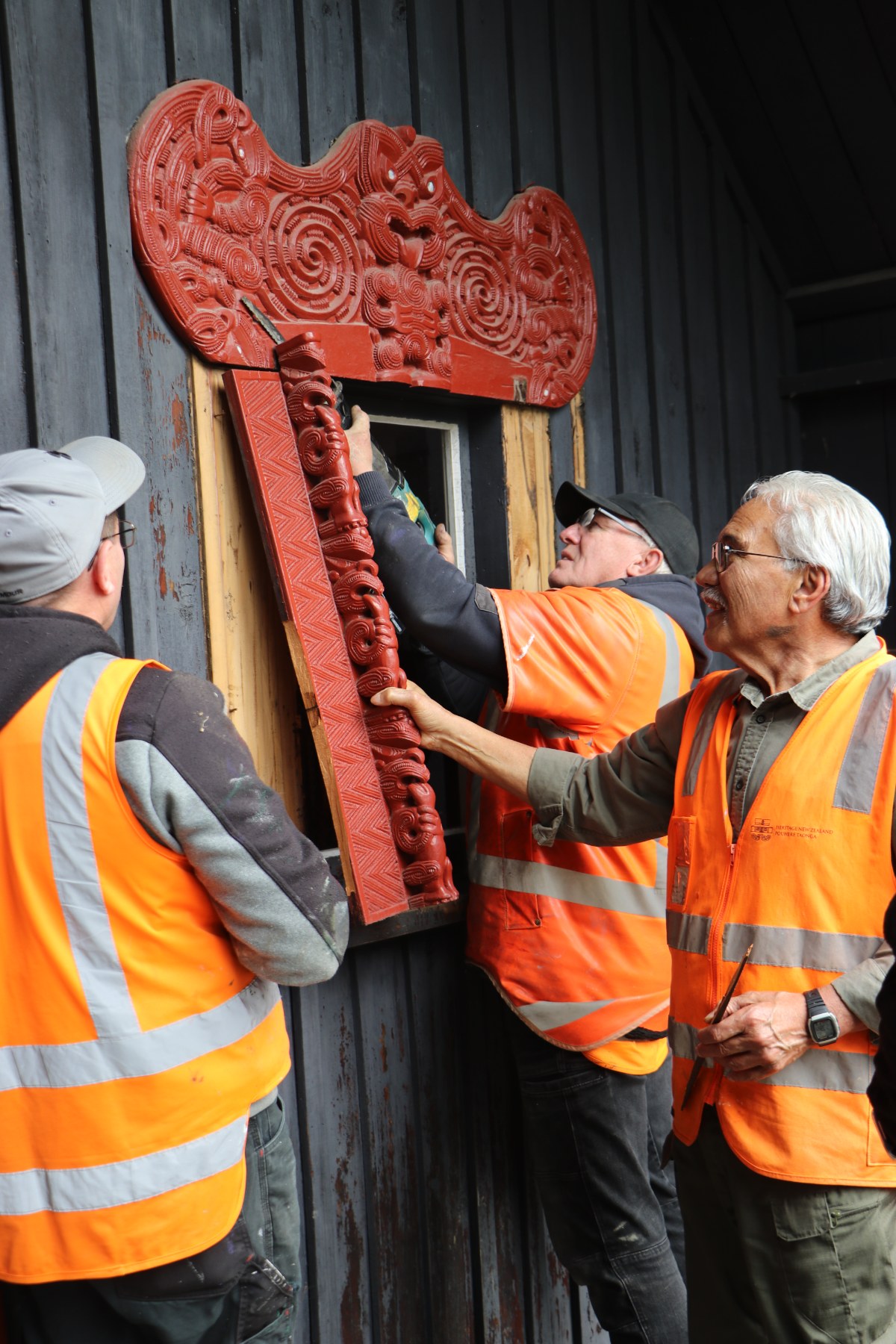
Invercargill’s oldest carved meeting house has once again come alive with the sound of
hammers and chisels, a century after the building and its decorative wooden carvings were
created.
Work began this month at Te Wharepuni o Anehana in Anderson Park to remove the
exterior carved panels, ahead of a project to preserve the taonga building for future
generations.
Celebrated Rotorua carver and marae conservation expert Jim Schuster would be leading
the restoration of the carvings, which were created by his great-great-grandfather Tene
Waitere in 1925.
Schuster said, including himself, three generations of Waitere’s descendants would be
involved in the project, with his nephew and grand-nephew planning to work alongside him.
“This whare is a wonderful example of my great-great grandfather’s work and the Ngāti
Tarāwhai style,” he said.
“I’m really happy to see this historic building get some well-deserved attention so it can
stand proud for another 100 years.”
Invercargill City Council Manager Parks and Recreation Caroline Rain said the project would
repair structural damage to the building, while restoring and preserving its artistic elements.
“We’re incredibly lucky to have the involvement of Schuster and his whānau, who we can
entrust to bring the carvings back to their original glory,” she said.
“With the carvings safely removed, we can get stuck into re-piling the building and repairing
the damage caused to the structure by borer and moisture over many decades.”
Te Wharepuni o Anehana is one of the oldest carved houses in the South Island and is
considered the southernmost example of work by a tohunga whakairo (master carver) in
New Zealand.
The whare is acknowledged as a wāhi tūpuna (place of Māori cultural significance) by
Heritage New Zealand, and was gifted to the city alongside Anderson House as part of a
bequest by Sir Robert Anderson’s family in 1951.
Schuster said it was expected to take 10 days of non-stop effort to clean, strip and repair the
panels.
“There are a lot of intricate details to get into and clean,” he said.
“Some of the panels that have cracked have been repaired with tar – they didn’t have
superglue or epoxy resin back then.”
Rain said the carved panels would be placed in storage until later in October, when Schuster
and his team would return to undertake the restoration, while repairs to the building were
expected to take about six weeks.
“We are looking forward to seeing the whare fully repaired and the restored carvings put
back in place, so they can continue welcoming visitors to Anderson Park for many years to
come.”