

Work to craft the perfect fit for artefacts taking shape at Te Unua
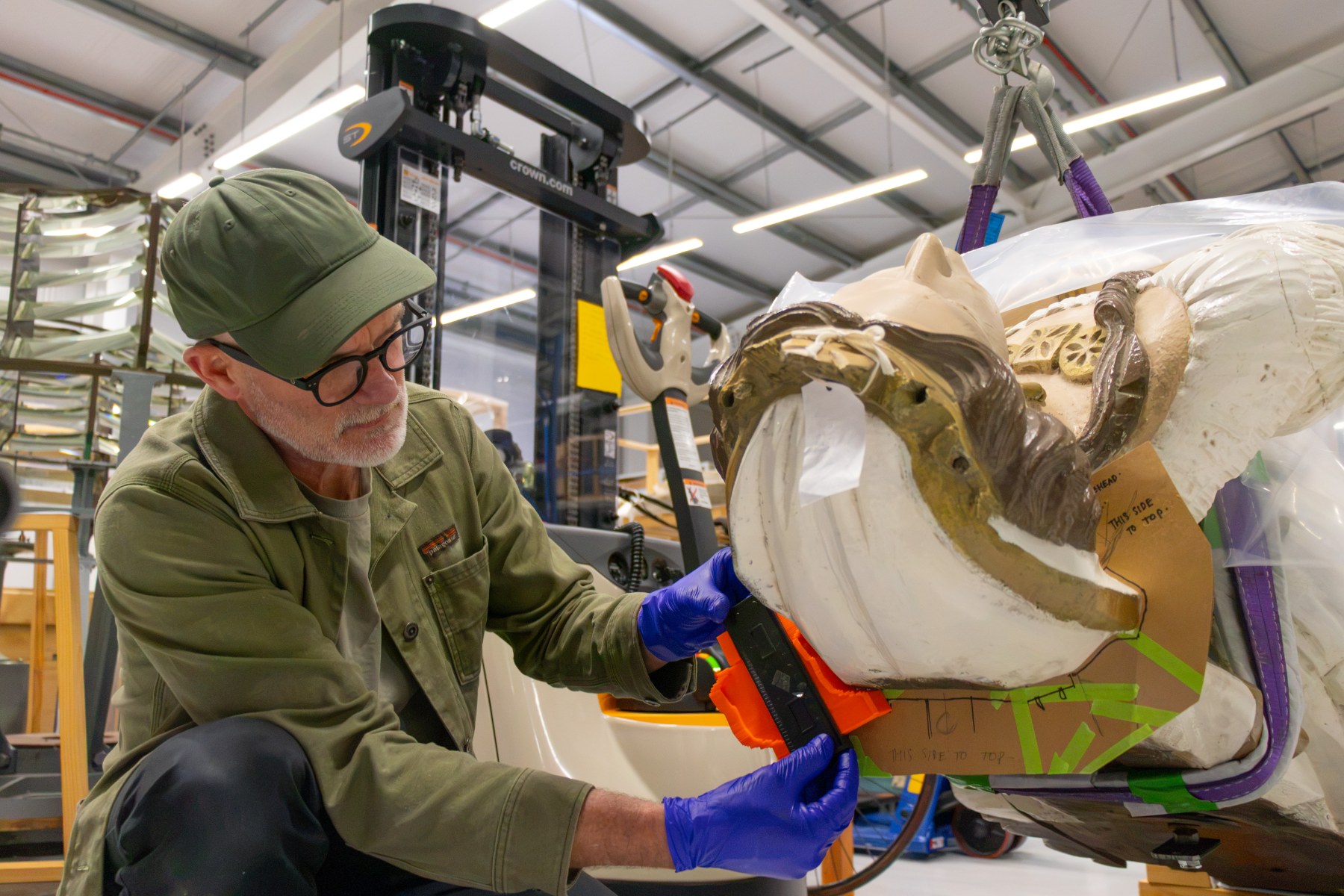
Object Support director, Stephen Brookbanks, with the figurehead from the barque England’s Glory. Collection of Te Kupeka Tiaki Taoka Southern Regional Collections Trust, 83.3395
“That end of things is definitely more challenging. For the mount making of an object like that, you’re veering into engineering. The machine we use to lift that is for lifting car engines, which gives you a sense of the scale needed in terms of its structural supports for display in a museum,” Brookbanks said.
At the other end of the scale, a mount for a set of bagpipes was also needed.
The bagpipes had belonged to prominent high-country pioneer, Scottish-born Donald Angus Cameron, who founded and leased the historic Nokomai Station (originally known as Glenfalloch) in northern Southland.
“You have to get it right. If the mount for the figurehead fails, it could wreck the case the item is in, it could wreck the object itself, and it could potentially hurt somebody. Whereas for items like the bagpipes, if you don’t get the mount right, they’ll just droop and look a bit sad,” Brookbanks said.
“That’s kind of the fun of it, to be honest. Some of the items you’re working with are really complex and heavy, but at the other end of the spectrum you’re working at jewellery scale, with delicate jewellers’ tools. That’s what makes it interesting: you get to cover that full spectrum.”
The process to design and build a mount was completely bespoke, with materials and techniques used dependant on the nature of the artefact itself. Larger artefacts could be crafted from a steel flat bar, while smaller mounts were fabricated in steel wire treated with a specialised plastic coating, Brookbanks said.
“You just try and come up with the simplest solution for each. The idea is that at the end of the day, the public comes in and has no idea of the work that has really led up to everything being displayed – to them, it all looks great.”
Physical construction of Te Unua was almost completed, with the museum set to open to the public in 2027.
To find out more about the development of Southland’s new regional museum, visit teunua.nz
